
Calling businesses, within the rules. Call professionals about matters related to their work. They must be able to opt out easily, and you only call individuals who have given their prior consent. For the rules that apply in the UK, see the official guidance from the ICO.
A salesperson spends the morning on the phone. Out of thirty numbers, four people pick up and only one agrees to a meeting. The pitch is rarely the problem. More often, the list is poorly targeted, the timing is wrong or the follow-up is forgotten.
This guide covers cold calling from start to finish: the target, the ground rules, the script, when to call, follow-ups and tracking. It draws on more than 3.4 million calls handled by our AI agents from October 2025 to September 2026. You will also see what AI cold calling software can take on, and what stays with your salespeople.
What is cold calling?
Cold calling means calling contacts who don’t know you yet, to open a sales conversation. On the first call, you aim for a meeting, a demo or an agreement to talk again. The sale comes later.
There are two situations:
- B2B cold calling: you call businesses about a need related to their work. It is the most common case for a service or a software product.
- Calling individuals: the rules are much stricter. With Starleads, you only call individuals who have given their prior consent. For most B2B companies, the question doesn’t arise.
The phone keeps a clear advantage over email: a real conversation. In two minutes, you know whether the need exists, who decides and when to talk again.
Is cold calling legal? What to check before you call
Calling businesses about their work is a common sales practice, but it is regulated. The rules depend on the country you call, and on whether you call businesses or individuals. They differ even within Europe, so check them before you open a new market.
For the UK, the ICO (Information Commissioner’s Office) sets out the official rules on ico.org.uk. Starleads campaigns follow three rules, and they make sense for any campaign:
- Honour opt-outs: a professional must be able to refuse your calls easily. You take it into account and don’t call them again.
- No calls to individuals without consent: you only call a consumer who has given their prior agreement.
- Announce the AI: if an AI agent makes the call, the person knows it from the start of the conversation.
In practice, check where your list comes from and keep a record of opt-outs. Log them in your CRM, so that no colleague calls back by mistake.
This summary is not legal advice.
How do you prepare for cold calling?
A good campaign is won before the first call. Three things decide your results: the list, the target and the goal of each call.
A clean, targeted list
200 well-chosen contacts beat 2,000 random numbers. For each business, you need to know:
- its sector and size;
- the person to reach and their role;
- why your offer might interest them now.
Remove duplicates, invalid numbers and contacts who have opted out of your calls. A clean list saves you wasted calls, and badly received ones.
A target you can describe
Write down the profile you are after in one sentence. For example: “estate agencies with 5 to 20 staff that get a lot of calls on Saturdays”. This sentence guides your choice of list, your opening line and your questions.
One goal per call
Decide what a successful call looks like: a meeting, a demo, or agreement to send a proposal. A clear goal keeps the call short and makes your results measurable.
What should a cold calling script include?
A script is a framework: it sets the order of the call and your answers to objections. You then adapt it to each person. The framework below has five steps, with a cold calling example.
- Introduce yourself in one sentence: your name, your company and why you are calling.
- Check you have the right person: “Are you the one who looks after incoming calls?”
- Ask a question about their day-to-day work: it opens the conversation and shows you know their job.
- Link their answer to your offer: one concrete benefit, not a list of features.
- Suggest a precise next step: a meeting slot, rather than “I’ll send you some information”.
Example, for an estate agency:
“Hello, this is Emma Clarke from Company X. I’m calling about the calls you get on Saturdays. Are you the one who looks after incoming calls? […] What happens when the whole team is out on viewings? […] Many agencies lose those calls because no one is there to pick up. I can show you how to get them back in fifteen minutes. Would Tuesday at 10:00 or Thursday at 14:00 suit you better?”
Also prepare three answers to the most common objections: “I don’t have time”, “Send me an email” and “We already have a solution”.
When is the best time for cold calling?
Call times matter as much as the pitch. In our data, one slot clearly stands out:
higher contact rate between 15:00 and 16:00, compared with the daily average
Another figure is surprising: the busiest slot for cold calling is Friday between 9:00 and 10:00. So many teams make their calls at a time when people are less likely to pick up.
| Time slot | What to take away |
|---|---|
| 15:00 – 16:00 | The best contact rate of the day: 27% above average |
| Friday 9:00 – 10:00 | The slot most used for cold calling, not necessarily the most effective |
| Lunch break | Best avoided if you want to reach a decision-maker |
These figures show a trend. Test two or three slots with your target over two weeks, then keep the ones where people pick up most.
How many times should you call a prospect back?
Few prospects answer the first call. The teams that book meetings set their follow-up rhythm in advance, and stick to it.
A simple cadence, to adapt to your sales cycle:
- Attempt 1 · Day 1First callLate in the afternoon.
- Attempt 2 · Day 2New callIn the morning, in a different slot.
- Attempt 3 · Day 4Third callThen a short voicemail.
- Attempt 4 · Day 7Last callThen a follow-up email or text.
Change the time slot at every attempt. A prospect who is always in meetings in the morning may be free at 15:00. This cadence is the most repetitive part of cold calling, and the easiest to hand over to an AI cold calling agent.
For a contact who has already left their details, speed matters too: a lead called within 5 minutes is reached 1.3 times more often than a lead called back after an hour. Follow-ups on quotes have their own logic, explained on our lead follow-up page.
How do you measure your cold calling results?
Without tracking, you don’t know what to change: the list, the script or the time slots. Track four indicators every week.
- Contact rate: the share of calls where someone picks up.
- Interest rate: the share of conversations where the prospect agrees to find out more.
- Meeting rate: the share of contacts reached who agree to a meeting.
- Average number of attempts before you reach a prospect.
A low contact rate points to the list or the time slots. A low meeting rate points rather to your opening line or your target.
Cold calling tips: the mistakes to avoid
The same mistakes come up in most teams:
- talking about your offer before listening to the need;
- giving up after a single unanswered call;
- always calling in the same time slot;
- noting nothing after the call, and losing the thread at the next one.
Each one can be fixed with method: listen first, plan your attempts, vary your time slots and log every call.
What can an AI agent do for your cold calling?
An AI agent takes on the most repetitive part: the first calls and the follow-ups. Your salespeople keep the conversations with interested prospects, where their experience counts.
With Starleads, Léa, your AI agent, calls your list in the time slots you set. She says she is an AI in her first message, asks your questions and notes the need. If no one answers, she calls back, up to 4 attempts. When a prospect is interested, she transfers them to your salesperson, or notes the meeting.
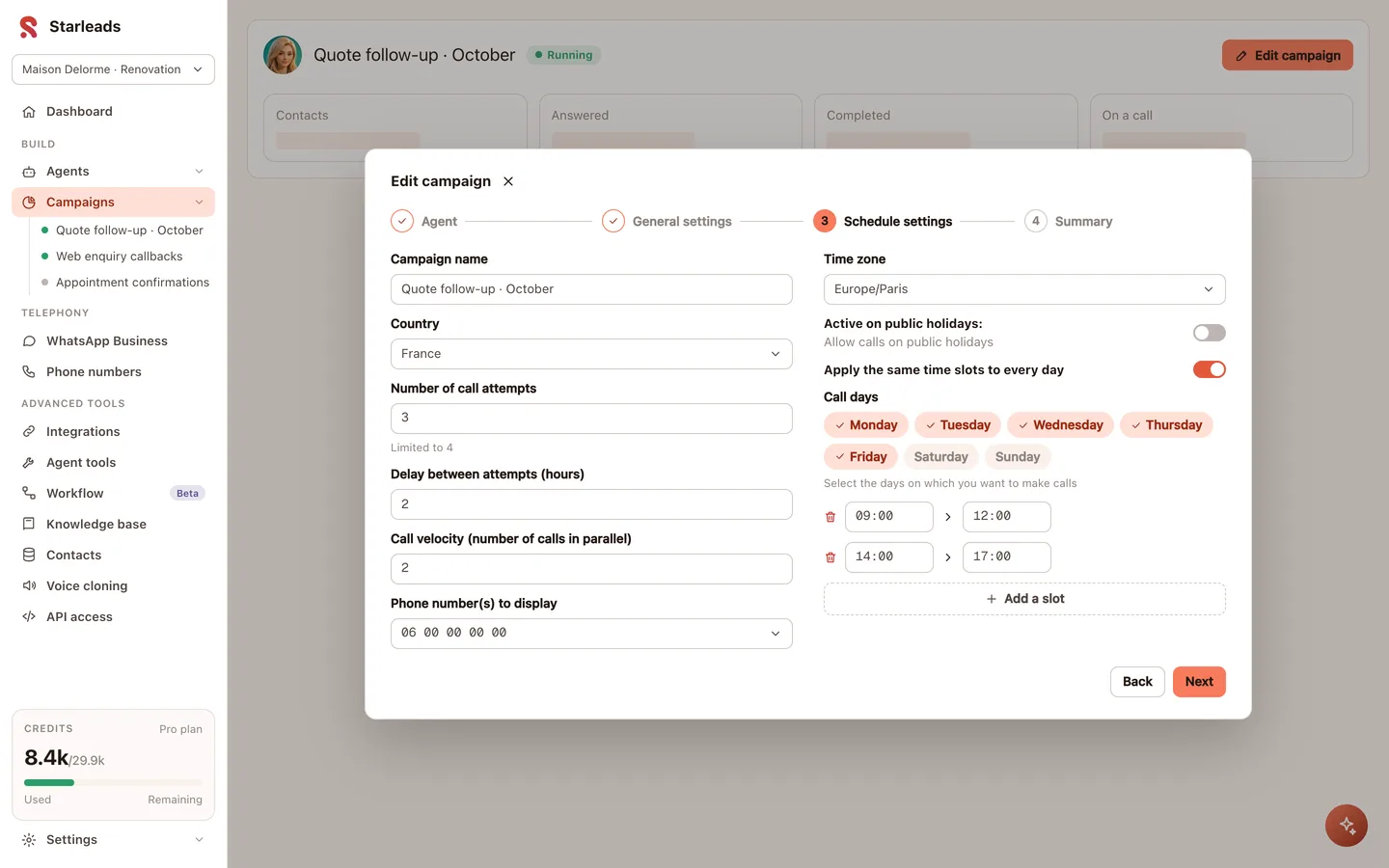
Each conversation comes with its transcript, a summary and a classification by topic, such as “Interested”. From Pro, a workflow (a chain of automatic actions) updates your CRM and sends a follow-up text. You stay in control: you decide the list, the questions and when Léa hands over.
Outbound calls are the bulk of our agents’ work: 99% of the calls they handle are calls they make themselves. To see how it works in detail, visit our AI cold calling page.
In short
Cold calling works when every step is prepared: a targeted list, a short script, the right time slots and follow-ups planned in advance. Measure your results every week, then adjust one thing at a time.
If your salespeople spend their days dialling numbers, hand the first calls to an AI cold calling agent. They can then focus on the conversations that lead to a meeting.