
It’s 12:40 at an estate agency. The phone rings three times, then goes to voicemail. The caller wanted to view a flat that afternoon: they ring the next agency on the list.
Phone etiquette shapes that first contact. It often decides what happens next, long before your offer or your prices. This guide gives you a charter to copy and example phrases for every situation. It also lists the mistakes that make callers hang up.
It also covers the calls nobody can take. For a typical Starleads customer, 12% of calls come in between 12:00 and 14:00, when reception is often closed. For those moments, an AI receptionist can back up your team.
What is phone etiquette?
Phone etiquette, or telephone etiquette, means a call answered quickly, a request understood and a clear next step for the caller. It rests on a few rules the whole team applies, whatever the size of the business.
Four signs show it’s working:
- The caller hears the company name as soon as you pick up.
- They don’t have to repeat themselves: their request is noted, or passed on with the transfer.
- If they wait, they’re told for how long, and someone comes back to them.
- They hang up with an answer, a transfer or a callback at a set time.
- Your teamAnswer and introduce yourselfBefore the third ring, company name first.
- The callerThey explain their requestAn open question, then you listen without interrupting and note their name.
- Your teamRephrase to check“If I’ve understood correctly, you’d like…”: you check before acting.
- Depending on the requestAnswer, transfer or take a messageAnswer if the information is certain, otherwise transfer or take a complete message.
- Your teamEnd with a clear next stepSum up what happens next, thank them, let the caller hang up first.
Tone matters as much as words. Smile when you pick up: your voice changes, and the caller hears it. Speak slowly when you give a name, a number or an address.
Phone etiquette at work concerns everyone who picks up: the office manager, the accountant between appointments, the tradesperson on site. Hence the value of a shared charter.
Phone etiquette rules: a charter to copy
A phone etiquette charter fits on one page. It sets the order of the call, the basic phrases and the rules everyone follows. Copy this template, then adapt the phrases to your trade.
| Step | What you say | Rule |
|---|---|---|
| 1. Answer | “Good morning, (company name), Sarah speaking.” | Before the third ring. Company name first. |
| 2. Offer help | “How can I help?” | An open question, then listen without interrupting. |
| 3. Identify the caller | “May I take your name, please?” | Note the name straight away and use it during the call. |
| 4. Rephrase the request | “If I’ve understood correctly, you’d like…” | Check before acting. A misunderstood request costs a second call. |
| 5. Answer or route | “I can help with that” or “I’ll put you through to the person handling your enquiry.” | Answer only if the information is certain. Otherwise, route the call. |
| 6. Put on hold | “May I put you on hold for a minute?” | Ask first. Come back to the caller if the wait drags on. |
| 7. Transfer | “I’ll put you through to Paul, who looks after quotes.” | Give the name and the department. Brief your colleague on the request. |
| 8. Take a message | “I’ll take down your request so he can call you back.” | Name, number, reason, availability. Read the number back aloud. |
| 9. Close | “Paul will call you back before 5pm. Thank you for calling, have a good day.” | Sum up the next step. Let the caller hang up first. |
Add three items specific to your business:
- the hours when someone answers, and what happens outside them;
- the transfer list: which reason goes to which person, with a back-up;
- the callback time you promise when a message is taken.
Adapting the charter to your trade
The structure stays the same everywhere. What changes are the reasons for calling and the details to note.
- Estate agency: note the property, the plan (buying, renting, selling) and availability for a viewing.
- Accountancy firm: ask for the client company’s name and the topic (tax return, payroll, year-end accounts) before transferring.
- Trades: note the address of the job, the type of work and how urgent it is. A burst pipe isn’t handled like a quote.
- B2B business: find out whether the caller is a customer, a prospect or a supplier. Each one goes to a different person.
Go through the charter with the team once a quarter. Reasons for calling change, and so do people.
Telephone etiquette examples, situation by situation
The following phrases cover the moments when people hesitate most. Replace the names with your own and keep the structure.
Answering the call
- “Good morning, (company name), Sarah speaking. How can I help?”
- “(Company name), good afternoon. How can I help you?”
- On a tradesperson’s mobile: “Hello, (company name), James speaking. I’m on a job, but go ahead.”
Your recorded greeting
The recorded message follows the same rule as a live voice: the company name, a greeting, then what happens next. Keep it short: the caller is waiting.
- Before the call is answered: “Hello, and thank you for calling (company name). A member of the team will be with you shortly.”
- While the caller waits: “Thank you for holding. An adviser from (company name) will be with you in a moment.”
- To route the call: “For a quote, please stay on the line. For an existing enquiry, please have your reference number ready.”
Update this message whenever your hours change or you close for the holidays.
Identifying the caller
- “May I take your name, please?”
- “Which company are you calling from?”
- “Do you have a reference or quote number?”
- “Could you spell your name for me? I want to get it right.”
Putting a caller on hold
- “Let me check your account. May I put you on hold for a minute?”
- “Thank you for your patience. I’m still looking into it, I won’t be a moment.”
- “This is taking longer than expected. I’d rather call you back in ten minutes.”
Transferring a call
- “I’ll put you through to Paul in our quotes team. Please hold.”
- “Paul is in a meeting. I can take a message or put you through to his colleague.”
- Before passing the call on: “I have Ms Taylor on the line, about a quote for a kitchen refit.”
Taking a message
- “Paul isn’t available at the moment. I’ll take down your request so he can call you back.”
- “What number, and what time of day, is best to reach you?”
- “Let me read your number back: 07700 900123. Is that right?”
Ending the call
- “To sum up: Paul will call you back tomorrow before midday about your tax return.”
- “Is there anything else I can help with?”
- “Thank you for calling, have a good day.”
Saying no politely
Some requests aren’t for you. Say so plainly, then offer a way forward.
- “We don’t do that kind of work. I can send you a list of our services.”
- “I can’t give out that information over the phone. I can book you an appointment with your adviser.”
- “We don’t give prices without a visit. Which day would suit you for us to come round?”
Phone etiquette at work: 6 mistakes that make callers hang up
These mistakes come up in most businesses. Each one loses a caller, and sometimes a customer.
- Letting it ring too long. After a few rings, the caller thinks nobody is there.
- Answering without introducing yourself. A bare “Hello?” leaves the caller wondering whether they’ve dialled the right number.
- Putting callers on hold without warning. Silence, or music with no explanation, and the caller hangs up.
- Transferring without a summary. Your colleague starts from scratch, and the caller repeats everything and gets annoyed.
- Promising a callback that never comes. A message taken and then forgotten disappoints more than a missed call.
- Having no plan when nobody is there. At lunchtime, in the evening or during a peak, voicemail alone lets requests slip away.
The first five can be fixed with the charter. The sixth needs organisation, or extra help.
When nobody can answer, what happens to your calls?
Even with a perfect charter, your team can’t take every call. Our data shows when calls slip through the most.
- Outside opening hours27%
- Between 12:00 and 14:00, when reception is often closed (typical customer)12%
Across Starleads customers, the weekly peak of inbound calls falls on Thursday between 10:00 and 11:00. At peak time, one person on reception can only take one call at a time. The others go to voicemail, or the caller hangs up.
You can stagger breaks to cover lunchtime. You can polish your voicemail greeting. You can also hand these calls to an AI agent, which answers for you.
With Starleads, simple call forwarding from your line sends these calls to Léa, your AI agent. She answers using your documents, takes the request or transfers the call, following your instructions. We recommend having her say she’s an AI in her first message. On average, the AI agent answered 99% of inbound calls.
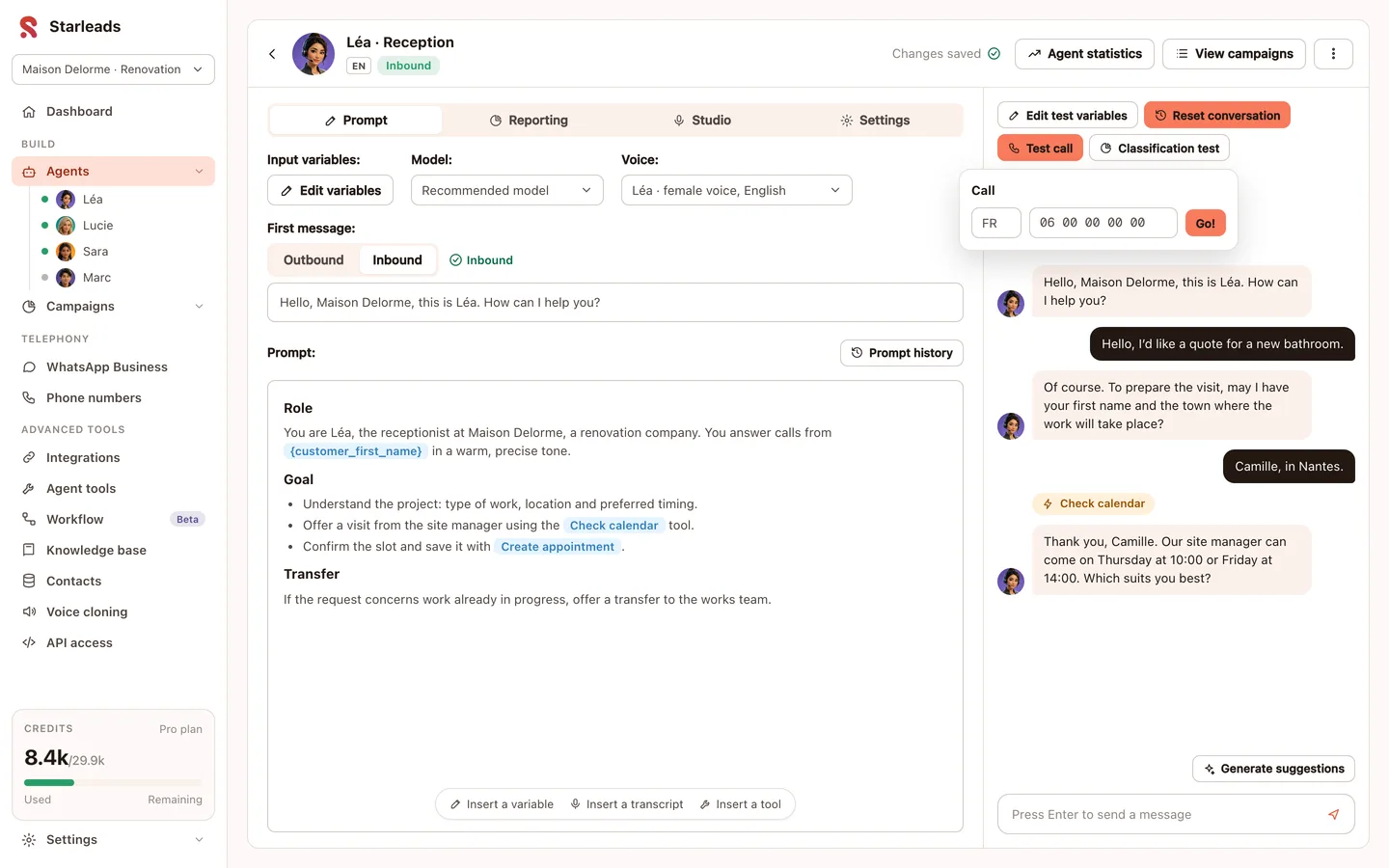
Your team then finds the call summary, sorted by topic. The details are on our inbound call handling page. For unanswered calls only, the AI answering service gathers what you need to call back. To organise your whole front desk, see our AI receptionist page.
Outsourcing your phone answering: answering service or AI agent?
Outsourcing your phone answering means handing your calls to a third party: a provider with people, or an AI agent. The two meet different needs.
| Criterion | Call answering provider | Starleads AI agent |
|---|---|---|
| Availability | According to the hours in the contract | 24/7, for the calls you hand over to it |
| Simultaneous calls | Depends on the provider’s team | 1, 5 or 10 depending on your plan |
| Unusual requests | A person adapts case by case | It follows your instructions and hands over in the cases you set |
| Answers about your business | According to the instructions you give the provider | Based on your documents: opening hours, prices, frequently asked questions |
| Follow-up | A message passed on by email or by phone | A summary, sorted by topic, in your workspace |
| What it asks of your team | Training the provider and keeping them informed | Keeping its instructions and documents up to date |
Before choosing, answer three questions:
- Which calls do you want to hand over? All of them, those at lunchtime and in the evening, or those that overflow when the line is busy.
- What should happen after the call? A message to call back, an appointment booked or a CRM record updated.
- Who keeps the information up to date? Prices, opening hours and transfer rules change. Someone has to pass them on.
A provider suits you if your calls often need human judgement. An AI agent suits you if your calls are similar and come in at any hour. The two can also work together.
Either way, your team takes the calls that need its expertise. With Starleads, plans start at €79 excl. VAT a month with a 12-month commitment, and you can try them free for 7 days, with no limits.
In short
Good phone etiquette comes down to a few rules: answer quickly, introduce yourself, understand the request and end with a clear next step. Write them down in a charter, share the example phrases and review it all with the team every quarter.
That leaves the calls nobody can take: at lunchtime, in the evening or during peaks. For those, an AI receptionist answers, informs callers and passes the request on to you. Your team can then focus on the callers who need it.