
Tuesday, 10:15. A plumber is lying under a boiler and his phone buzzes in his pocket. He can’t answer. At midday, he finds two missed calls and a barely audible message, with no number to call back.
He then asks himself what many business owners ask: do I need a virtual receptionist? This guide compares the two possible answers: a service run by people, or an AI agent. We make an AI agent and don’t sell a human receptionist service. So we also say where people do better.
You’ll find our data on the calls that come in when nobody can answer. You’ll see what drives the price, then a grid to help you choose. You’ll also see how an AI receptionist works, and how to combine it with a human team.
What is a virtual receptionist?
A virtual receptionist answers your calls on your behalf, in your company’s name, without sitting in your office. The service steps in when your team is away, busy or closed. The caller gets a simple answer, or leaves a complete request that you receive afterwards.
In the UK, the term usually means an outsourced team of receptionists working remotely. Several terms come up in searches, with some nuances:
- A virtual receptionist answers in your company’s name, takes messages and transfers calls. The service often covers set times: lunch, holidays, busy periods, sometimes evenings.
- A call answering service focuses on the calls you miss. It answers, gives basic information and passes on the message.
- A virtual assistant or PA usually goes further. They also manage your diary, screen calls and can handle small admin tasks.
The service can also be internal. A colleague takes the line in turns over lunch, or keeps the on-call phone on Saturday. It costs nothing extra, but that person isn’t doing their own work in the meantime.
For a few years now, a third option has existed: the AI receptionist, also called an AI voice agent or callbot. It answers itself, holds a conversation with the caller and follows your instructions.
When do you need a virtual receptionist?
Before choosing a solution, look at when your calls come in. Our AI agents take calls for companies in many sectors. Their data shows the moments when nobody is there to answer.
- Outside opening hours27%
- Before 9:00 or after 18:0015%
- Between 12:00 and 14:00 (typical customer)12%
- At the weekend9%
The weekly peak of inbound calls falls on Thursday between 10:00 and 11:00. These figures partly overlap. A call at 19:00 on a Saturday counts both at the weekend and after 18:00: don’t add them up.
The Thursday morning peak raises another problem. Your team is there, but each person takes one call at a time. The next calls ring out or go to voicemail.
Our agents have handled more than 11,000 calls outside opening hours that would otherwise have gone to voicemail.
For your own business, start from your own figures. Your phone provider can often give you a breakdown of missed calls by hour. Spot your gaps: lunchtime, the end of the day, Saturday or the peaks.
What a human receptionist does well, and what slips through
A person on the line keeps real advantages, and they deserve to be recognised.
- They hear emotion. A worried or annoyed customer is reassured by a voice that adapts to them.
- They handle the unexpected. A caller mixes three requests, or reports a leak on a Sunday. They find a sensible answer on the spot.
- They add nuance to the message. “The customer is torn between two properties and seems in a hurry”: that kind of detail helps you call back at the right time.
- They reassure callers who want a human. Some callers hang up as soon as they realise they are talking to a machine.
For a law firm that receives sensitive calls, these qualities count for a lot.
A human service also has limits, which come from how it is organised:
- One call at a time per person. At peak times, the next calls wait or go to voicemail, depending on how the provider is set up.
- Hours fixed in the contract. Nights, Sundays or bank holidays aren’t always included.
- Instructions to pass on. Every change of prices, hours or contact person has to be shared with the provider.
- Messages of varying quality. They depend on who took the call and how busy they were at the time.
What an AI agent changes for your calls
An AI agent answers as soon as the call comes in, at any hour. On average, the AI agent answered 99% of inbound calls.
With Starleads, call forwarding from your line brings your calls to Léa, your AI agent. You choose when: all the time, when you don’t answer or when the line is busy. That depends on what your phone provider allows.
What Léa changes in practice:
- Several calls at the same time. 1 with Starter, 5 with Pro, 10 with Business. At the Thursday peak, your callers don’t wait for a line to free up, within the limits of your plan.
- Answers drawn from your documents. Opening hours, prices, areas covered, frequently asked questions: you add them to her knowledge base.
- A complete request. For a typical customer, the agent fills in the useful details itself in 70% of conversations: need, availability, interest.
- Transfers according to your rules. You say which cases go to a person, and to which number.
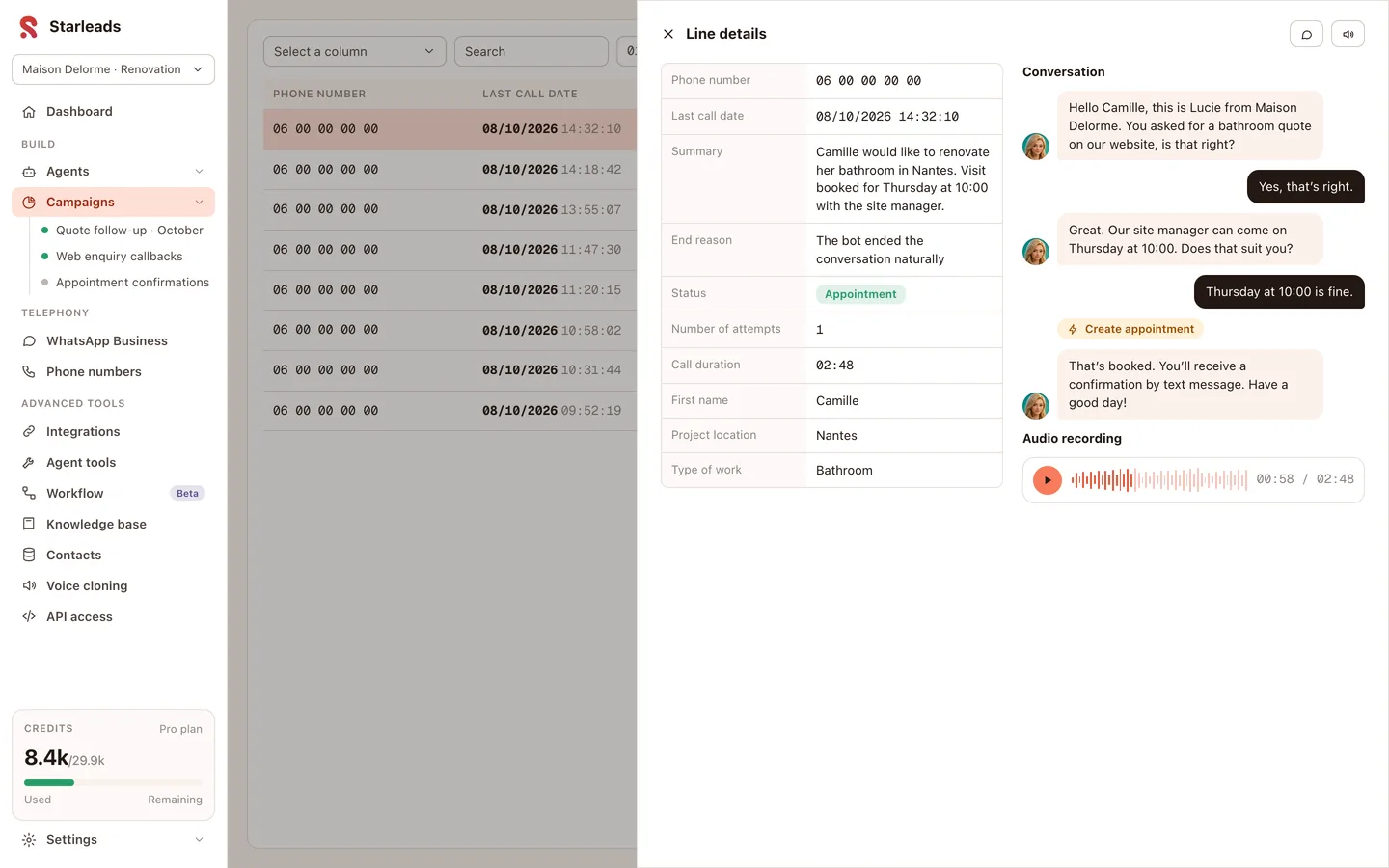
- A written follow-up. After the call, you find the summary, the topic and the recording in your workspace.
- Your customerA customer calls after closing timeYour call forwarding sends the call to Léa.
- Léa · PhoneLéa answers and repliesShe draws on your documents: opening hours, prices, areas covered.
- RuleYour instructions decideA question answered, a message taken or a transfer to the right number.
- Your teamYour team takes overSummary, topic and recording in your workspace.
From Pro, Léa can also book a slot in your calendar and trigger a workflow (a chain of automatic actions). For example, a confirmation by SMS or a record updated in your CRM.
An AI agent has limits too:
- It only knows what you have given it. When information is missing, it follows your instructions: ask a question, take a message or transfer the call.
- It doesn’t replace a person’s judgement in a delicate situation. A dispute or a very unhappy customer should go to your team.
- Some callers prefer a human. We advise you to have Léa say she is an AI in her first message. Plan a transfer, too, for when the caller asks for one.
Human or AI receptionist: the comparison table
The table covers the criteria that matter to most businesses. The last column says, for each line, which option comes out ahead.
| Criterion | Human virtual receptionist | Starleads AI agent | Takeaway |
|---|---|---|---|
| Availability | During the hours set in the contract | 24/7, for the calls you hand over | Advantage: AI agent |
| Simultaneous calls | One per available person | 1, 5 or 10 depending on your plan | Advantage: AI agent at peak times |
| Unexpected requests | A person improvises an answer | It follows your instructions and hands over in the cases you planned | Advantage: human |
| Worried or unhappy callers | Listening and reassurance | Transfer to your team, if you planned it | Advantage: human |
| Message quality | Depends on the person and how busy they are | Written summary, topic, recording | More consistent with the AI agent |
| Appointment booking | Depends on the contract and access to your calendar | From Pro, in your connected calendar | Possible with both |
| Cost | Depends on the package, hours and volume | From €79 excl. VAT a month with a 12-month commitment, each inbound call counted | See the next section |
| What it asks of your team | Briefing the provider and keeping them informed | Keeping its instructions and documents up to date | A comparable effort |
Read this table starting from your own calls. If most of them are alike (opening hours, quotes, appointments), the AI agent covers the need well. If many of them need tact or a decision, a person remains the safer choice.
An AI receptionist doesn’t force you to choose one over the other. It answers first and transfers delicate cases to your team.
If you only want to cover unanswered calls, an AI answering service is often enough. Léa steps in when nobody answers, and you get what you need to call back.
How much does a virtual receptionist cost?
No single virtual receptionist price applies to every business. The bill depends on a few variables, to check on every quote.
- How you are billed. A monthly package with a set number of calls, or payment per call or per minute. Check the price of calls beyond the package.
- The hours covered. Office hours only, or lunchtime, evenings, Saturdays and bank holidays too.
- Call volume and length. A busy month can go beyond the package.
- Extra services. Appointment booking, diary management, transfers, messages sent by SMS, a custom greeting script.
- Contract terms. Set-up fees, minimum term, notice period.
To compare two quotes, apply them to your actual volume from last month, calls beyond the package included. That is often where the real gap shows.
With Starleads, the AI agent starts at €79 excl. VAT a month on Starter with a 12-month commitment. You get credits for the whole year, with no monthly quota. An inbound call uses 28 credits on Starter with the 12-month commitment, or 36 with no commitment, whatever its length (1 credit = €0.01 excl. VAT).
Pro, at €239 excl. VAT a month with a 12-month commitment, adds the calendar, SMS, workflows and 5 simultaneous calls. You can try it free for 7 days first, with no limits. The details are on our pricing page.
How do you choose, or combine both?
Answer these five questions. They point you towards a human service, an AI agent or both.
| Question | If yes, choose… |
|---|---|
| Are your calls mostly recurring questions (opening hours, quotes, availability)? | An AI agent |
| Do several calls come in at once at certain times? | An AI agent |
| Do you get calls in the evening, at lunchtime or at weekends? | An AI agent, or a human service with those hours in the contract |
| Do your callers often need reassurance or advice? | A person |
| Do your calls often need a decision on the spot? | A person |
Many businesses find themselves in both columns. They then combine the two.
The AI agent answers first. It handles common questions, takes requests and, from Pro, books appointments. Delicate cases go to a person: a partner, an on-call adviser or your current receptionist service. You put the number in its instructions.
An estate agency, for example, hands the agent viewing requests and questions about properties. Negotiations and unhappy customers stay with its negotiators. For how to answer the phone and the phrases to use, see our guide to phone etiquette.
In short
A human virtual receptionist remains the best option when your calls need tact or a quick decision. An AI agent suits you better when your calls are alike, come in at any hour or all at once.
Start by listing your missed calls: at lunchtime, in the evening, at weekends and at peak times. Then try an AI receptionist at those moments. Your team keeps the calls that need it.